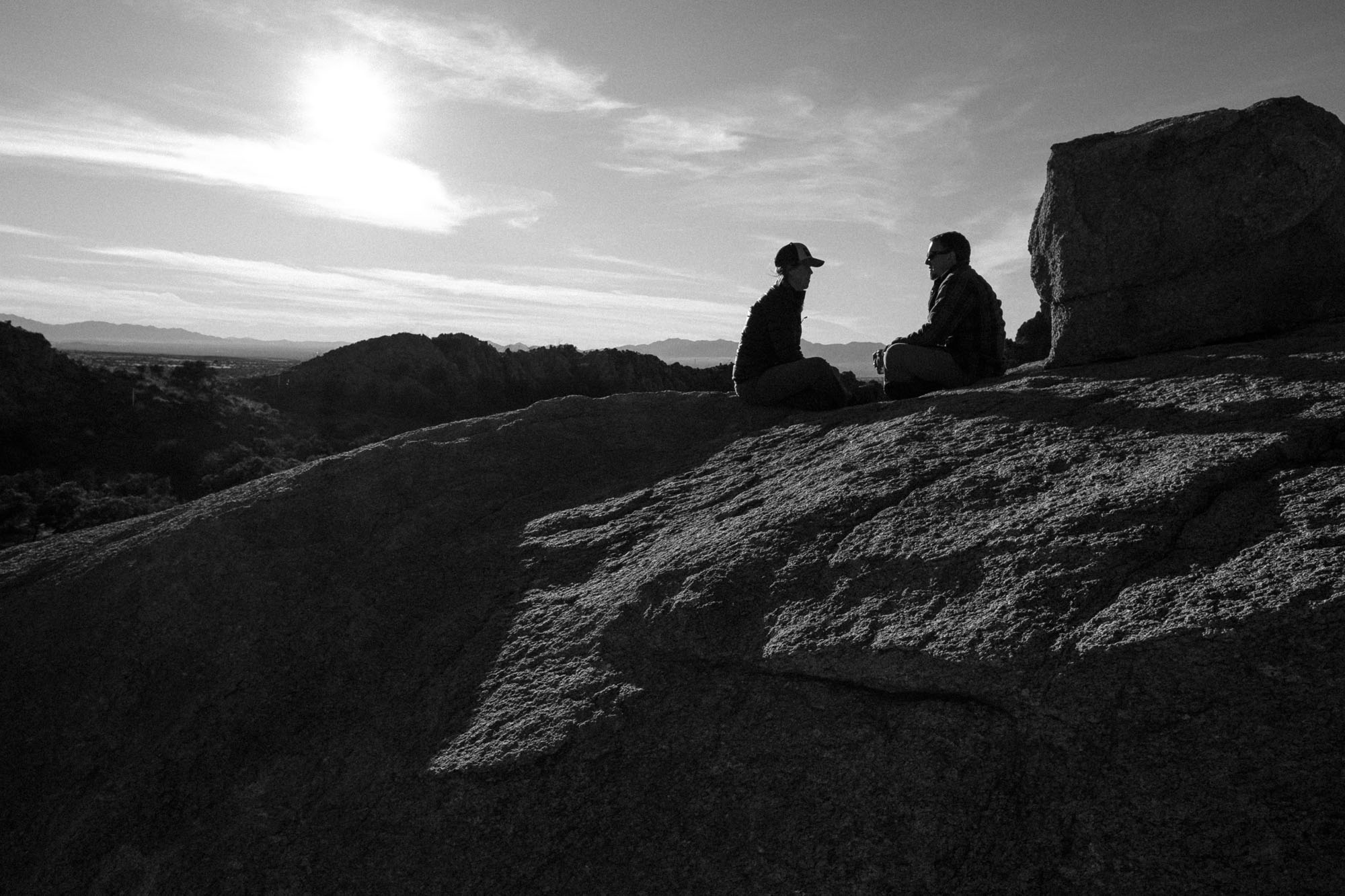
Contemplating our mortality is not necessarily a fun topic to wrestle with internally or discuss amongst friends. However, it’s a vital and deeply important one. Mark and I believe that to fully, truly, and deeply experience life, you must fully, truly, and deeply confront the fact that one day you will die. That belief prompts us to consider and discuss our mortality often. We don’t shy away from talking about death. In fact, the more we think about death, the greater our appreciation for life becomes.
The Spectrum of Fear and Recklessness
There are many ways to be in relationship with your aliveness. On one end of the spectrum is living with so much fear of death that you never truly live. You shelter yourself from every possible risk, you never take any chances, never push yourself outside your comfort zone, and never discover what can be found on the other side of fear. You play it safe in order to live as long as possible. This is a life rooted in and completely controlled by fear. It is a way of living that is out of touch with the fact that we have no control over our mortality. Life is a risk, and the only thing we’re guaranteed is death. Any one of us could die today or live to be 100, no matter how safe we play it.
The other side of the spectrum is living with reckless abandon—having so little fear of death that you tempt fate on a regular basis. You have zero risk aversion and are out of touch with your fragility. But just like those living in fear, you could die today or live to be 100. While playing it safe might improve your statistical odds, it offers a false sense of security. The truth is, we have absolutely no control over when our timeline ends.
Mark and I fall somewhere in the middle of that spectrum. We aren’t adrenaline junkies—far from it—but we do have a deep desire to experience as much joy and wonder as we can while we get to live this one “wild and precious life,” as poet Mary Oliver put it. We may not be big risk-takers, but we do love being reminded of how small and insignificant we are. When we gaze up at the Milky Way and contemplate the endless string of miracles that had to take place in order for us to ever be born in the first place, we feel overcome with awe and gratitude. When we stand on a mountaintop where we could accidentally slip off a cliff face to our death, we can deeply sense our fragility. When we see bear prints or mountain lion scat around camp, we’re reminded that simply being in the wrong place at the wrong time could be what abruptly brings our lives to an end.
Confronting Our Aliveness
Both Mark and I have been fortunate enough to live through more than one near-death experience. It goes without saying that we’re deeply grateful to have survived those moments. What might come as a surprise, though, is how grateful we are to have experienced the feeling of almost dying.
To almost die is to most deeply confront your aliveness. When you can sense the lights about to go out for good, when you have the thought, “Is this it?” and then you survive, that’s when you are most in touch with what it means to be alive. That’s when your mortality becomes palpable rather than a vague concept.
I’m not encouraging anyone to go seek out a near-death experience. I’m trying to convey how deadly it is to live in fear. And when I say “deadly,” this is what I mean: living in fear kills your ability to appreciate life and to truly, deeply LIVE. Fear of death is an avoidance of the inevitable. Avoidance leads to the desire to try to forget or numb our uncomfortable feelings around mortality. We turn to the plethora of distractions available at our fingertips, making it easy to live in avoidance. But living in denial and avoidance completely robs us of the ability to be awed by the profundity of our existence.
No matter how deeply we bury our heads in the sand, one important fact will always remain true: “Everything is a gift, and nothing lasts.” Francis Weller, author of The Wild Edge of Sorrow, says this is life’s most difficult but essential teaching. She drives the point home by stating, “Everything we love, we will lose, no exceptions.” It’s not just our own mortality that we’re challenged to make peace with, but the mortality of everything around us—from our loved ones to our pets, to our health, our homes, and our careers. Nothing is permanent.
Appreciating the Here and Now
Mark reminds me from time to time that one of us, one day, will be alone. I never enjoy hearing those words, but that doesn’t mean I don’t appreciate them. We are each other’s rock, and because of how deeply we can count on the presence and support of the other, I have a harder time accepting the inevitable loss of our partnership than I do my own mortality. That’s precisely why I appreciate Mark reminding me that we won’t have one another forever. It reignites my appreciation for what we have now. It makes inconsequential grievances easier to move on from. It causes us to wake up every single morning and smile at one another with gratitude for the fact that we get to spend another day together.
One of the things I love most about living a mobile lifestyle is that it forces me to appreciate the here and now. We rarely spend more than two weeks in one place. If there is a hike I want to go on, a sight I want to see, or if I simply want to discover what a place has to offer, I have to do it now. In two weeks, we’ll be somewhere new and the opportunity will be lost. When we lived in a house, the opposite happened. All the things I wanted to do and experience in my local area were constantly pushed to the back burner. I always felt like there would be time to do those things later. Those houses are now distant memories, and so are the things I always wanted to do but never got around to doing.
That period of my life is a direct example of the kind of existence I don’t want to live. I don’t want to reach my seventies or get diagnosed with a terminal disease next year only to be left wishing I’d lived my life differently.
Certainty, security, and permanence are things we crave deeply as humans, but pursuing them accomplishes no more than a dog does when chasing its tail; it breeds frustration and anxiety. Embracing uncertainty, insecurity, and impermanence fills our lives with gratitude and hones our ability to appreciate the here and now.
Put your phone down. Go outside. Take a deep breath. Look around. Take it all in. Go on a walk with someone you love. Laugh. Cry. Call a friend. Make plans to do the thing you’ve always wanted to do.
These are the things you can do now, because none of us knows what tomorrow has in store.
Leave a Reply